

01 Sep ROOTS OF PEACE – A Tree in the History of Civilizations
Long before the olive tree became one of the most recognizable features of the Mediterranean landscape, humans had learned how to cultivate it, preserve its fruit, and extract its oil.
Its history developed alongside the earliest agricultural communities of the Mediterranean.
Archaeology, palaeobotany, and genetics now reveal a much more complex process than was once believed. There was probably no single moment when a wild olive tree suddenly became a cultivated plant. Over generations, different communities selected and propagated the trees they considered most useful.
From this long relationship emerged a crop that would profoundly shape the economy, landscape, and culture of the Mediterranean.
The earliest cultivations
Wild olive trees were present in the Mediterranean long before the emergence of agriculture. What changed was the relationship between these trees and human communities.
In the southern Levant, very early evidence has been found of both olive oil production and olive cultivation. Genetic analyses also identify the Levant as a key region in the early history of the domestication of the cultivated olive tree.
Growing an olive tree required something special: patience.
Those who planted a young tree could not expect an immediate harvest. They had to imagine a future several years ahead.
Olive cultivation therefore encouraged continuity, knowledge of the land, and the transmission of skills from one generation to the next.
Olive oil also had valuable qualities. It could be stored, transported, and used for food, lighting, and body care.
The olive tree was no longer just a tree. It was becoming part of an organized agricultural and economic system.

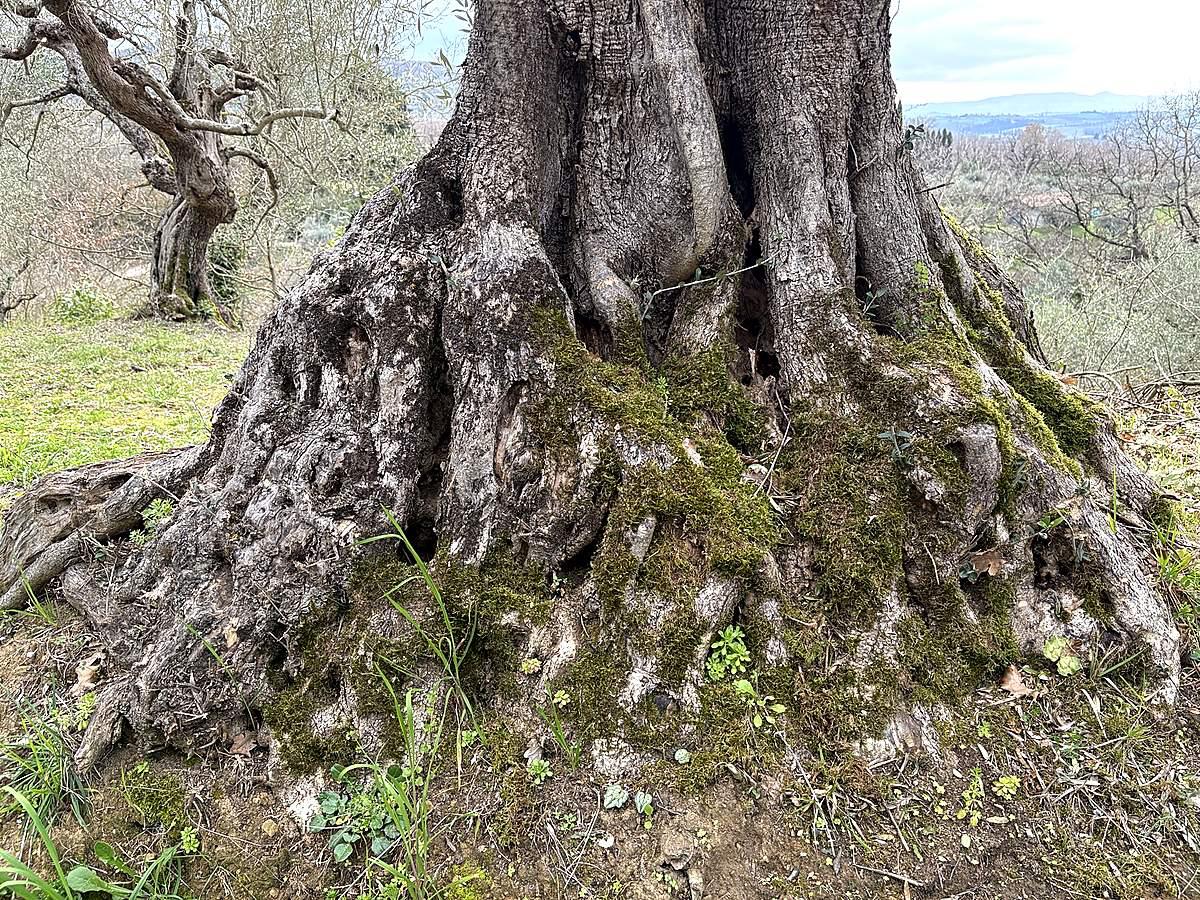
The Olive Tree in Mediterranean Civilizations
As contacts between the peoples of the eastern Mediterranean intensified, the olive tree gradually acquired an increasingly important economic and cultural role.
Crete and the Aegean world played an important part in the ancient history of olive cultivation. Later, in Greek civilization, the olive tree became deeply associated with religion, mythology, and public life.
The best-known tradition linked the tree to the goddess Athena. Its leaves also became part of public ceremonies: a wreath of olive branches was awarded to the winners of the ancient Olympic Games.
But its role in everyday life was even more important.
Olive oil was used as food, stored in amphorae, burned in lamps, and traded along the routes of the Mediterranean.
The Phoenicians, Greeks, and later the Romans all contributed to the spread of olive cultivation. During the Roman period, olive production extended across vast areas of the eastern Mediterranean, Italy, North Africa, and the Iberian Peninsula.
A Tree Shared by History
The journey of the olive tree was not simply the movement of a plant from one place to another.
Knowledge travelled with it.
Farmers had to learn how to propagate the trees, prune them, harvest their fruit, and adapt cultivation to different soils and climates.
Studies of ancient pollen now allow us to reconstruct at least part of this expansion. After the emergence of important early areas of cultivation in the Levant and the Aegean, olive growing gradually spread through Anatolia, Italy, the Iberian Peninsula, and other Mediterranean regions.
The sea played a decisive role.
For ancient civilizations, the Mediterranean was not merely a space that separated peoples. It was also a great route of communication.
Ships carried olive oil, people, agricultural techniques, and new knowledge.
In different regions, cultivated olive trees also came into contact with local populations of wild olives. This long process contributed to the extraordinary genetic diversity that still characterizes the species today.


Next Month: The Gardens of Peace
In October, Roots of Peace will reach the present day.
We will discover the Gardens of Peace, places where olive trees from different countries grow together and become living ambassadors of dialogue, biodiversity, and cooperation.