
Scientific and varietal section
Hojiblanca
Country
Spain
Use
Dual purpose
Continental distribution
Europe · Oceania
A structuring variety of Andalusian olive-growing territories
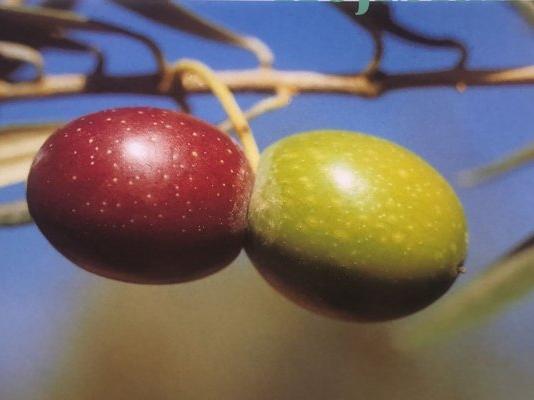
Hojiblanca is a Spanish olive variety with a dual purpose, used both for oil production and as a table olive. It is deeply linked to southern Spain and, in particular, to Andalusia, where it contributes significantly to the character of the agricultural landscape.
Its presence is not incidental, but structural: entire olive-growing areas have developed around this cultivar, which forms part of complex agricultural systems based on a long historical, social and productive continuity.
Within the Gardens of Peace, Hojiblanca represents Spain and bears witness to the value of mature territorial biodiversity: a variety that tells the story of the close relationship between cultivar, farming communities and Mediterranean landscapes.
Identity and synonyms
Hojiblanca is a cultivar originating from Spain, strongly associated with Andalusian olive growing. Its name refers to the pale colour of the underside of the leaves, a feature that contributes to the visual identification of the variety.
Among the traditional denominations and synonyms associated with the variety are Casta de Cabra, Casta de Lucena and Lucentino, names that reflect its connection with specific territorial contexts in southern Spain.
Geographical distribution
In Europe, Hojiblanca is deeply linked to southern Spain and particularly to Andalusia, where it is one of the structuring cultivars of olive-growing landscapes.
The variety is also present in Oceania, as an introduced cultivar within olive-growing systems developed in more recent times, in contexts where olive cultivation has been built from Mediterranean models adapted to new environments.
Agronomic and commercial considerations
Hojiblanca is a variety with a high rooting capacity, resistant to calcareous soils and considered rustic due to its resistance to drought and tolerance of winter cold.
Entry into production is intermediate. Flowering time ranges from medium to late; the variety is self-compatible and its pollen is of medium quality. Ripening is late and productivity is high, although alternating.
The fruits show a high resistance to detachment, a characteristic that can make mechanical harvesting more difficult. The cultivar has a dual purpose and, because of the consistency of its pulp, is considered very suitable for black processing in the Californian style. Oil content is low, although the oil is appreciated for its quality.
The variety is considered susceptible to peacock spot, olive knot and verticillium wilt; it is also poorly resistant to the olive fruit fly and anthracnose.
Territorial presence and cultural value of the variety
Hojiblanca is a stable presence in Andalusian olive-growing landscapes. Its European roots lie within a Mediterranean context in which the olive tree represents a long-standing element of identity and production.
Within the framework of the Gardens of Peace, Hojiblanca is an expression of mature territorial biodiversity: a variety that does not only speak of the diffusion of the olive tree, but also of permanence, continuity and the deep relationship between cultivar, farming communities and specific territories.
Cultural and symbolic section
Hojiblanca in The Garden of Peace project
Hojiblanca represents Spain in the varietal collection of the Gardens of Peace. It brings into the project the strength of Andalusian olive-growing landscapes, where the olive tree is an agricultural, social and cultural presence capable of uniting memory, labour and Mediterranean identity.
The olive tree as a shared landscape
In The Garden of Peace project, Hojiblanca becomes a sign of the deep bond between the olive tree, territory and farming communities.
Its presence recalls Andalusia and the great Mediterranean landscapes in which the olive tree is not only a crop, but an element that shapes space, preserves memory and accompanies people’s lives.
Biodiversity and dialogue between territories
Placing Hojiblanca alongside the other varieties of the Gardens of Peace means recognizing olive biodiversity as a living heritage made of cultivars, territories and different agricultural knowledge.
Each variety carries a specific story. In the Garden of Peace, these stories do not remain separate, but form a common language based on care for the land and respect for identities.
Education, peace and responsibility
The presence of Hojiblanca in the Gardens of Peace offers visitors the opportunity to discover a Spanish variety of great value and to understand the cultural meaning of biodiversity.
Educating for peace also means learning to read a landscape, recognizing the work of farming communities and transforming knowledge of varieties into respect, responsibility and dialogue among peoples.
The varietal collection of The Garden of Peace brings together the 28 olive varieties represented in the Gardens of Peace around the world. Each Garden may host a specific selection from this collection.