
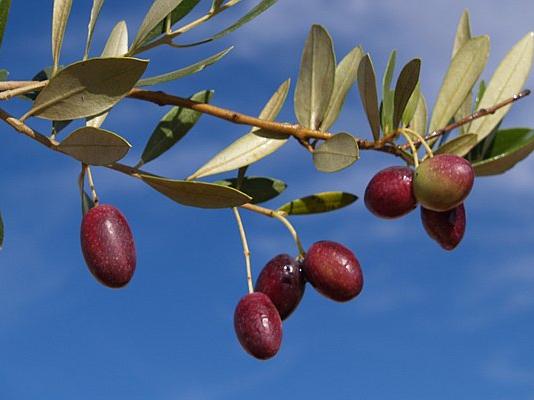
Scientific and varietal section
Picholine Marocaine
Country
Morocco
Use
Dual purpose
Continental distribution
Africa
A Moroccan variety symbolising North African olive growing
Picholine Marocaine is one of the most representative olive varieties of Morocco and of North African olive growing. Its identity is closely linked to Moroccan agricultural landscapes, where the olive tree has accompanied rural life, food production and Mediterranean culture for centuries.
It is a dual-purpose cultivar, used both for oil production and for table olives. This versatility has favoured its central role in local olive-growing systems, making it a reference variety for production, processing and the enhancement of Morocco’s agricultural heritage.
Within the Gardens of Peace, Picholine Marocaine represents Morocco and expresses the relationship between biodiversity, Mediterranean landscape, rural knowledge and cultural continuity among the communities of the southern Mediterranean.
Identity and synonyms
Picholine Marocaine is a traditional Moroccan cultivar, widely associated with the olive-growing identity of the country. Its name recalls the Picholine family, but the Moroccan variety has a specific territorial value and strong recognition within the North African context.
Correct varietal identification is important in order to distinguish Picholine Marocaine from other cultivars with similar names. Locally, it may be linked to traditional denominations and forms of use connected with different growing areas, confirming the relationship between variety, territory and agricultural culture.
Geographical distribution
The distribution of Picholine Marocaine is mainly linked to Morocco and to the African context of the western Mediterranean. In this territory, the variety plays a highly significant role in both traditional and productive olive-growing landscapes.
In North Africa, the olive tree represents an element of continuity between the Mediterranean environment, inland areas, family farming systems and local production chains. Picholine Marocaine emblematicly expresses this relationship between cultivation, landscape and national identity.
Agronomic and commercial considerations
Picholine Marocaine is a dual-purpose variety, suitable both for oil production and for processing as a table olive. This characteristic strengthens its agronomic and commercial interest, because it allows different productive uses within the olive supply chain.
From an agronomic point of view, the variety is appreciated for its adaptability to North African Mediterranean environments, characterised by hot summers, variable water availability and traditional cultivation systems. Its presence in Moroccan landscapes bears witness to the olive tree’s ability to integrate into different environments while maintaining productive and cultural value.
Commercially, Picholine Marocaine represents a strategic cultivar for Morocco, both for the oil market and for the table olive market. Its dual destination allows the product to be enhanced in different forms, strengthening the link between local production, quality, tradition and territorial recognition.
Territorial presence and cultural value of the variety
Picholine Marocaine is linked to the rural landscapes of Morocco, where the olive tree is an integral part of food culture, the agricultural economy and the memory of communities. The variety expresses an ancient relationship between land, work, processing and the culture of olive oil.
Within the framework of the Gardens of Peace, this cultivar represents Morocco through an agricultural heritage that speaks of biodiversity, Mediterranean hospitality and cultural continuity. Picholine Marocaine reminds us that every olive variety preserves a specific story and contributes to dialogue among peoples through the universal language of the land.
Cultural and symbolic section
Picholine Marocaine in The Garden of Peace project
Picholine Marocaine represents Morocco in the varietal collection of the Gardens of Peace. It brings into the project the voice of North African olive growing, of southern Mediterranean landscapes and of an agricultural culture in which the olive tree is food, work, hospitality and shared memory.
The olive tree as Morocco’s Mediterranean root
In The Garden of Peace project, Picholine Marocaine evokes Morocco and the deep bond between the olive tree, landscape and rural life. It is a variety that speaks of cultivated fields, olive processing, oil production and the transmission of agricultural practices rooted in time.
Its presence in the Gardens of Peace transforms a productive and identity-bearing cultivar into a symbol of continuity: the olive tree becomes a bridge between generations, territories and cultures of the southern Mediterranean.
Biodiversity, encounter and southern Mediterranean landscapes
Picholine Marocaine reminds us that olive biodiversity also lives in major territorial varieties, capable of supporting agricultural supply chains, local economies and collective identities. Its dual purpose brings together oil production and table olives, showing the richness of the olive tree’s forms of use.
In the Gardens of Peace, this variety dialogues with the other olive trees as a sign of encounter between Africa, the Mediterranean and Europe. Morocco thus enters a shared narrative, where each cultivar helps build a mosaic of countries, landscapes and agricultural cultures in relationship.
Education, peace and responsibility
Discovering Picholine Marocaine means approaching a variety that teaches the value of versatility, adaptation and care for agricultural heritage. The olive tree becomes an educational instrument for understanding how a cultivar can support communities, economy, landscape and culture.
In the Gardens of Peace, Picholine Marocaine invites visitors to recognise biodiversity as a shared responsibility. Protecting a variety means protecting an agricultural story, a territory and a possibility of dialogue among different peoples through the universal language of the olive tree.
The varietal collection of The Garden of Peace brings together the 28 olive varieties represented in the Gardens of Peace around the world. Each Garden may host a specific selection from this collection.