
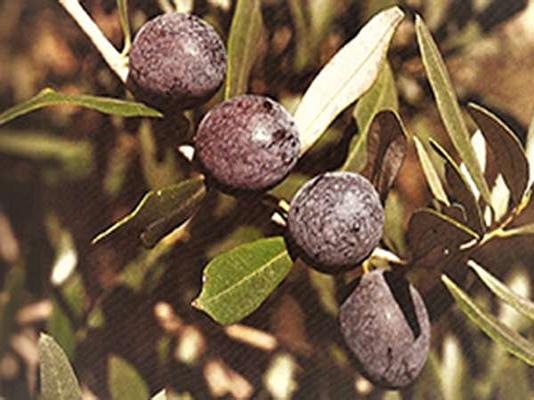
Scientific and varietal section
Doebli
Country
Syria
Use
Dual-purpose
Continental distribution
Asia · Africa
A variety from the Eastern Mediterranean
Doebli is a Syrian olive variety with a dual-purpose use, cultivated mainly in the areas of Latakia, Tartous and Tel-Kalakh. Its distribution, covering around 7% of the olive-growing surface, makes it a significant cultivar within Syria’s agricultural heritage.
It is a variety associated with relatively humid environments, where the olive tree has a long-standing productive and cultural role. Its presence in the Gardens of Peace helps tell an important part of the olive biodiversity of the Eastern Mediterranean.
In Italy, within the itinerary of the Gardens of Peace, Doebli represents Syria and becomes a concrete sign of the varietal richness that connects different territories, cultures and agricultural landscapes.
Identity and synonyms
Doebli is a cultivar originating from Syria, classified as dual-purpose: it can therefore be used both for oil production and as a table olive.
The synonyms reported for this variety are “Dremlali” and “Tamrani”, names that refer to local traditions and different cultivation contexts.
Geographical distribution
Doebli is mainly distributed in the Syrian areas of Latakia, Tartous and Tel-Kalakh.
It occupies around 7% of the olive-growing surface, a figure that confirms its importance within the Syrian varietal landscape.
Agronomic and commercial considerations
This variety adapts well to humid areas, but has low tolerance to drought. Its rooting capacity from semi-hardwood cuttings is medium. Entry into production is late. It flowers early; it is considered self-compatible and has a low percentage of ovarian abortion. Productivity is high and alternate. Ripening is early and the fruits show low resistance to detachment. Oil content falls within average values.
It appears to be resistant to olive leaf spot (Cycloconium oleaginum), olive knot (Pseudomonas savastanoi) and verticillium wilt.
Territorial presence and cultural value of the variety
Doebli is linked to Syrian territories where the olive tree belongs to the agricultural, economic and cultural life of local communities. Its value is not only productive, but also landscape-related and identity-forming.
Within the Gardens of Peace, this variety represents Syria through a living, concrete and recognizable presence: an olive tree carrying agricultural memory, biodiversity and dialogue among Mediterranean cultures.
Cultural and symbolic section
Doebli in The Garden of Peace project
Doebli represents Syria in the varietal collection of the Gardens of Peace. It brings into the project a testimony from the Eastern Mediterranean and from its ancient olive-growing civilization.
The olive tree as a shared language
In The Garden of Peace project, Doebli becomes a sign of continuity among peoples who, although speaking different languages, recognize the olive tree as a common symbol of roots, care and permanence.
Its Syrian origin recalls one of the historic areas of the Eastern Mediterranean, where the olive tree is not only an agricultural crop, but also a daily, familiar and cultural presence.
Biodiversity and dialogue
Placing Doebli alongside other varieties from different countries makes the biodiversity of the olive tree visible as a shared heritage.
Each cultivar preserves its own characteristics, yet in the Garden of Peace they all take part in the same narrative: diversity does not divide, but enriches the common landscape.
Education and responsibility
The presence of Doebli in Italy offers visitors the opportunity to discover a variety linked to another Mediterranean territory and to understand that peace also passes through knowledge.
Educating people about biodiversity means learning to recognize the value of what is different, fragile and precious: an agricultural, cultural and civic responsibility.
The varietal collection of The Garden of Peace brings together the 28 olive varieties represented in the Gardens of Peace around the world. Each Garden may host a specific selection from this collection.