
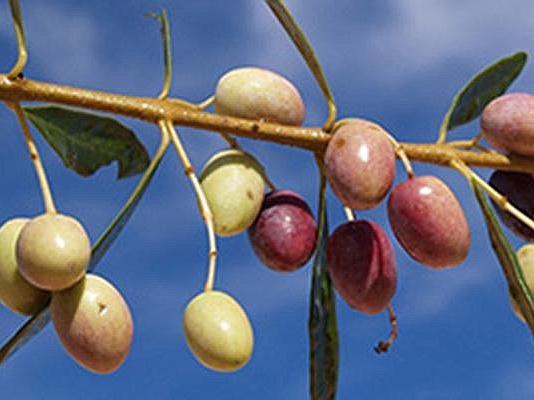
Varietal profile
Scientific and varietal section
Chemlal de Kabylie
A Mediterranean mountain olive landscape
Chemlal de Kabylie is an Algerian cultivar deeply connected to Greater Kabylia, where the olive tree grows within inland, hilly and mountainous landscapes. In these territories, cultivation is not only agricultural production, but also adaptation to difficult slopes, changing exposures and demanding environmental conditions.
The variety tells the story of an olive-growing culture shaped over time through local practices, grafting, selection and territorial continuity. Its spread and its many forms are the result of a long relationship between rural communities, soil, climate and the olive tree's ability to root itself in complex environments.
Among North African cultivars, Chemlal de Kabylie represents one of the most significant expressions of traditional Algerian olive growing, combining productive value, climatic resilience and a strong territorial identity.
Identity and synonyms
Chemlal de Kabylie is a cultivar originating from Algeria, particularly associated with the territories of Kabylia. It is mainly used for olive oil production and belongs to the North African varietal heritage.
Documented synonyms include “Achamlal”, “Achamli”, “Achemlal”, “Chemlal Blanche d’Ali-Chérif”, “Chemlal”, “Chemlal de L’Oued-Aissi”, “Chemlal de Tizi-Ouzou”, “Chemlal Précoce de Tazmalt” and “Petit Chemlal Pendant”.
Geographical distribution
The distribution of Chemlal de Kabylie is linked to Africa and, in particular, to northern Algeria. The variety is associated with the olive-growing landscapes of Kabylia, where the olive tree develops in inland and hilly Mediterranean territories.
Its presence testifies to the role of olive growing in North African territories, where agricultural management must deal with slopes, different soils, variable water availability and the need for climatic adaptation.
Agronomic and commercial considerations
A cultivar of Greater Kabylia, it has colonised the most difficult slopes. It is a self-incompatible cultivar with early flowering and therefore requires pollinators with relatively early flowering. The cultivar most commonly used for this purpose is “Azeradj”, which flowers at the same time. It is a vigorous variety with an open growth habit and high productivity, although affected by alternate bearing.
The cultivar has low rooting ability, but responds well to grafting, including on wild olive trees, which probably explains its wide diffusion and the multiplicity of forms. Ripening is late and fruit detachment resistance is high. The oil produced is of excellent quality, although the yield is low. It is resistant to cold and high temperatures.
It is considered moderately tolerant to olive leaf spot (Cycloconium oleagineum), but sensitive to verticillium wilt (Verticillium dahliae) and olive knot (Pseudomonas savastanoi).
Territorial presence and cultural value
Chemlal de Kabylie represents a mountain and community-based olive-growing culture, where the cultivation of the olive tree has adapted to complex landscapes and demanding environmental conditions.
Its history reminds us that Mediterranean olive biodiversity does not belong only to coastal areas, but also to inland territories, slopes and communities that have transformed the olive tree into a stable element of agricultural and cultural identity.
The Garden of Peace
Cultural and symbolic section
Chemlal de Kabylie in The Garden of Peace project
Chemlal de Kabylie invites us to see the olive tree as a presence capable of rooting itself in difficult landscapes, transforming the resilience of the land into memory, identity and dialogue among communities.
The olive tree as a shared language
Within The Garden of Peace project, Chemlal de Kabylie reminds us that the olive tree can become a common language even when it grows in mountainous, inland and complex territories. Its presence within the international collection testifies to the value of varieties rooted in local communities and landscapes of memory.
Biodiversity and dialogue
In the Gardens of Peace, Chemlal de Kabylie represents biodiversity as an encounter between adaptation, territory and culture. Each variety helps build a shared narrative in which agricultural differences become opportunities for knowledge and dialogue among peoples.
Education and responsibility
The presence of Chemlal de Kabylie in The Garden of Peace project becomes an invitation to recognise the value of traditional agricultural landscapes and the varieties that inhabit them. Protecting biodiversity also means preserving stories, communities and forms of balance built over time.
The varietal collection of The Garden of Peace includes the 28 olive varieties represented in the Gardens of Peace around the world. Each Garden may host a specific selection of this collection.